The Entrepreneur Toolkit
13 tools for founders — 5 strategic canvases plus 8 data-driven charts. From idea validation to investor pitch, everything you need in one place.
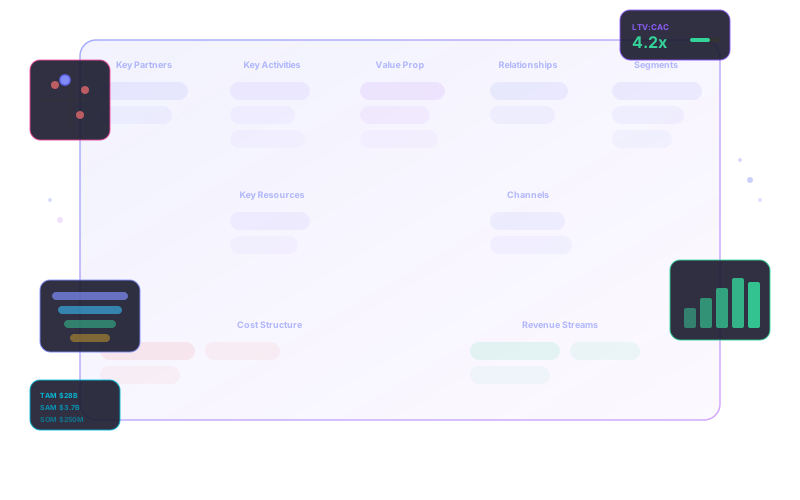
What is the Business Model Canvas?
The Business Model Canvas is a strategic management tool that lets you visualize, analyze, and design the essential elements of a business on a single page. Developed by Alexander Osterwalder and Yves Pigneur, it maps out nine interconnected building blocks — showing exactly how your organization creates, delivers, and captures value.
Whether you're a first-time founder or a seasoned executive, the canvas gives you a shared language for strategy discussions and a powerful lens for spotting assumptions that need testing.
Clarification
Cut through complexity and define your business's core elements with crystal clarity — so everyone on your team starts from the same page.
Analysis
Examine how every building block interacts and influences the others, revealing hidden dependencies and untapped opportunities.
Design
Prototype, iterate, and refine new business models — or strengthen existing ones — with a structured yet flexible framework.
When to Use the Business Model Canvas
The canvas adapts to every stage of your journey — from validating a napkin idea to realigning a mature organization.
Startup Phase
Define and validate your initial business model before committing significant resources.
Growth Phase
Adapt and scale your model as markets evolve, new competitors emerge, and customer needs shift.
Pivoting
Explore new directions confidently by mapping out alternative models side-by-side.
Established Business
Keep your strategy current with ongoing optimization and cross-team alignment.
9 Components of the Business Model Canvas
Together these nine sections give you a complete, 360° view of how your business creates and captures value.
Customer Segments
Identify the distinct groups of people or organizations your business serves. Understanding your segments helps you tailor every other building block precisely to their needs.
Value Propositions
Describe the bundle of products and services that create value for each customer segment — from newness and performance to price, convenience, and risk reduction.
Channels
Map your communication, distribution, and sales touchpoints across the five channel phases: Awareness, Evaluation, Purchase, Delivery, and After-Sales.
Customer Relationships
Define how you attract, retain, and grow your customer base — ranging from personal assistance and communities to fully automated self-service experiences.
Revenue Streams
Capture how your business generates cash from each segment — asset sales, subscriptions, licensing, brokerage fees, advertising, and more.
Key Resources
List the most important physical, intellectual, human, and financial assets needed to make your business model work.
Key Activities
Identify the critical tasks your business must execute — production, problem-solving, or platform and network management — to deliver on your value promise.
Key Partners
Build your ecosystem of suppliers, allies, and co-creators who help you optimize operations, reduce risk, and access resources you can't efficiently own yourself.
Cost Structure
Understand all costs incurred to operate your business model — fixed vs. variable, cost-driven vs. value-driven — and find opportunities to optimize them.
How to Create Your Canvas Online
Four simple steps stand between you and a fully mapped business model.
01
Access the Online Generator
Open the Entrepreneur Toolkit right here on this site — no installation or design experience required.
02
Fill in the Nine Sections
Enter your ideas into each of the nine building blocks using guided prompts that keep you focused on what matters.
03
Iterate Freely
There's no prescribed order — start wherever it feels natural. Revisit and refine sections as your thinking evolves.
04
Update Regularly
Your business model is a living document. Keep it current to stay aligned with market shifts and strategic pivots.
Tips for an Effective Canvas
Keep It Simple
Focus on the key components. Resist the urge to overload the canvas with detail — clarity beats comprehensiveness at this stage.
Collaborate with Your Team
Involve diverse stakeholders to surface blind spots, gather varied perspectives, and build shared ownership of the strategy.
Test and Validate
Treat each assumption as a hypothesis. Run experiments, gather real-world feedback, and update your canvas accordingly.
Review Continuously
Markets move fast. Schedule regular canvas reviews to stay proactive rather than reactive as your environment changes.
Your Founder Journey
Not sure where to start? Follow this path from idea to investor pitch.
1
Map Your Model
Get your entire business on one page. Understand customers, value, revenue, and costs.
2
Size Your Market
Quantify how big the opportunity is. Investors always ask — have the answer ready.
3
Prove Unit Economics
Calculate CAC, LTV, and payback period. Know if your business model actually works.
4
Track Growth
Measure your pirate metrics and recurring revenue. Find where users drop off.
5
Know Your Competition
Find your positioning gap. Understand your strengths vs. the market.
6
Build Your Pitch
Auto-fill a pitch deck from everything above. Export and share with investors.
13 Tools, One Platform
Canvases for strategy. Charts for data. Everything a founder needs from day one to Series A — no spreadsheets, no slide decks, no switching between apps.
Product & Market Alignment
Lean Canvas
Define the Problem, Solution, Unfair Advantage, and Key Metrics — perfect for validating startup ideas before writing code.
Value Proposition Canvas
Drill into customers' jobs-to-be-done, pains, and gains, then align them with your product.
Competitor Positioning Map
Plot yourself and competitors on a 2D chart to find your positioning gap and whitespace.
Growth & User Tracking
AARRR Funnel (Pirate Metrics)
Map the full user journey — Acquisition, Activation, Retention, Referral, Revenue — and see where you're losing people.
Cohort Analysis
Track retention rates of different user groups over time to see if product changes improve stickiness.
Financial Health
Burn Rate & Runway
Track cash against expenses to know how many months you have left.
MRR Growth
Track predictable monthly revenue — new subscriptions, upgrades, and churn.
Unit Economics
Calculate CAC, LTV, payback period, and LTV:CAC ratio with a visual health gauge.
TAM/SAM/SOM Calculator
Size your market across segments — Total, Serviceable, and Obtainable market.
Strategy & Investor Readiness
SWOT Analysis
Map Strengths, Weaknesses, Opportunities, and Threats to find strategic gaps.
Kano Model
Prioritize features into Must-Haves, Performance, and Delighters.
Pitch Deck Builder
Auto-fill a structured pitch deck from your canvases and tools. Export as PDF.
Frequently Asked Questions
Everything you need to know before you start building.
It provides a clear, visual snapshot of your entire business model on a single page — making it far easier to spot strengths, expose weaknesses, and communicate your strategy to investors, partners, and teammates. The structured format also accelerates strategic planning sessions and keeps everyone aligned.
Absolutely. Startups benefit most from the canvas because it forces early-stage founders to articulate their assumptions before investing significant time or money. It's the fastest way to stress-test a business idea and identify the riskiest unknowns that need validation first.
None at all. The tool is designed for entrepreneurs, product managers, and strategists of all experience levels. Guided prompts walk you through each section so you always know what to think about — no MBA required.
Yes. Every canvas and chart can be exported as PNG, PDF, or JSON, and you can generate a public shareable link so investors and collaborators can view your work instantly — no account needed on their end.
Look for a tool that offers a clean, distraction-free interface, real-time collaboration, easy export options, and the ability to save multiple canvases. Our generator is built with exactly those priorities in mind, so you can focus on strategy instead of wrestling with the tool.
Ready to build your startup strategy?
13 tools. 5 canvases. 8 charts. From idea validation to investor pitch — everything you need to turn your startup into a strategy machine.